Summary
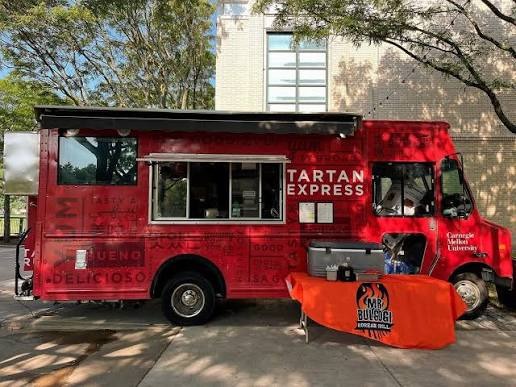
Mr. Bulgogi is a Korean food truck that shows up on Carnegie Mellon's campus a few weeks a semester and reliably sells out. For a Decision Analysis course, I worked with a team of four to answer the question CMU Dining Services actually has to answer: should Mr. Bulgogi stay a seasonal pop-up, become a permanent restaurant, or stay a pop-up while a competing Korean restaurant opens permanently instead? I led the data side, designing the student survey, building the Even Swaps and NPV models, and pressure-testing the recommendation against the assumptions it depended on.
The Decision
The decision sits with CMU Dining Services, weighing three real objectives at once: student satisfaction, building a base of regular customers, and profit. Three alternatives were on the table:
Go permanent
Establish Mr. Bulgogi as a full-time, on-campus restaurant.
Stay the course
Keep Mr. Bulgogi exactly as it is: a seasonal food truck, nothing added.
Pop-up + competitor
Keep the truck seasonal, but let a new Korean restaurant open permanently alongside it.
Turning Opinions Into Dollars
We ran a 104-respondent student survey and went directly to the sources for operating data, emailing Mr. Bulgogi's owner for cost figures and CMU Dining Services for contract and space-availability context. Student satisfaction isn't naturally priced, so we used Even Swaps to convert it into dollar terms: we asked what students would be willing to pay for a bowl, for eating weekly, for the option to eat there again, and for a "significant," "moderate," or "slight" improvement in satisfaction, then applied those rates against each alternative's projected traffic. That let satisfaction sit inside the same financial model as rent, ingredients, and revenue, rather than being a bullet point next to it.
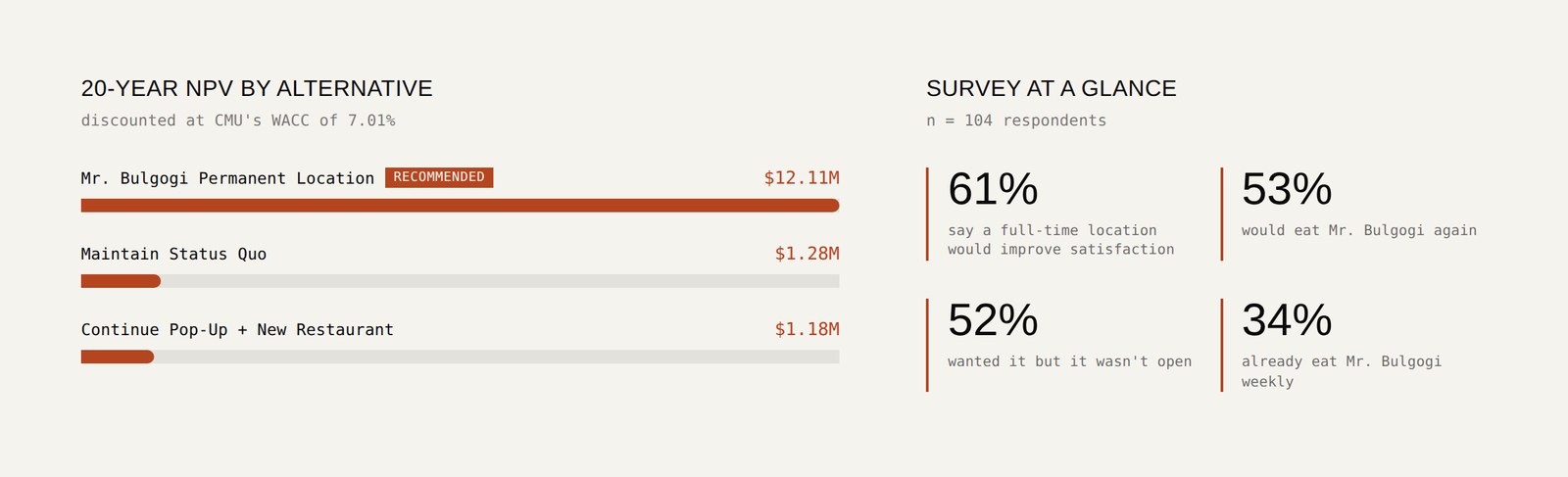
Each alternative's monetized cash flows were then projected over a 20-year horizon and discounted using CMU's own weighted average cost of capital (7.01%), calculated from the university's 2024 financial statements: the same discount rate a university treasurer would actually use, not a generic assumption.
What the Model Found
Going permanent wins by a wide margin. Its 20-year NPV comes in roughly ten times higher than either staying seasonal or ceding the permanent slot to a new competitor, driven less by the extra open days themselves than by unmet demand the survey surfaced directly: over half of respondents said they wanted Mr. Bulgogi but it simply wasn't open when they were looking, and a majority said a full-time location would meaningfully improve their satisfaction with campus dining.
Stress-Testing the Recommendation
A model is only as trustworthy as its shakiest assumption, so we built two-way sensitivity tables (discount rate against improvement rate, and improvement rate against carryover rate) spanning a wide range around our base-case estimates. Going permanent stayed the top choice in every single combination we tested. That mattered more than the headline number: it meant the recommendation didn't depend on us guessing the exact right inputs, just the right direction.
Recommendation
We recommended that CMU Dining Services open Mr. Bulgogi as a permanent, full-time restaurant on campus. It's projected to substantially outearn either alternative over a 20-year horizon, the result holds up under a wide range of assumptions, and it directly answers demand the survey data made hard to ignore: students who already wanted this and couldn't get it.