Summary
Meet Me at My POV is a two-sided, magnet-driven maze exhibit designed with a team of three to teach perspective-taking through gameplay rather than explanation. Two visitors stand on opposite sides of a shared board, each seeing a different maze layout, controlling magnetically linked pieces that move together, so solving it requires describing what you see, guessing what your partner can't, and coordinating around constraints neither of you can fully see. I worked across exhibit design and physical prototyping, then led the formative evaluation: designing the study, observing 10 visitor groups in the field, and analyzing what the data said about whether the exhibit actually taught what it was built to teach.
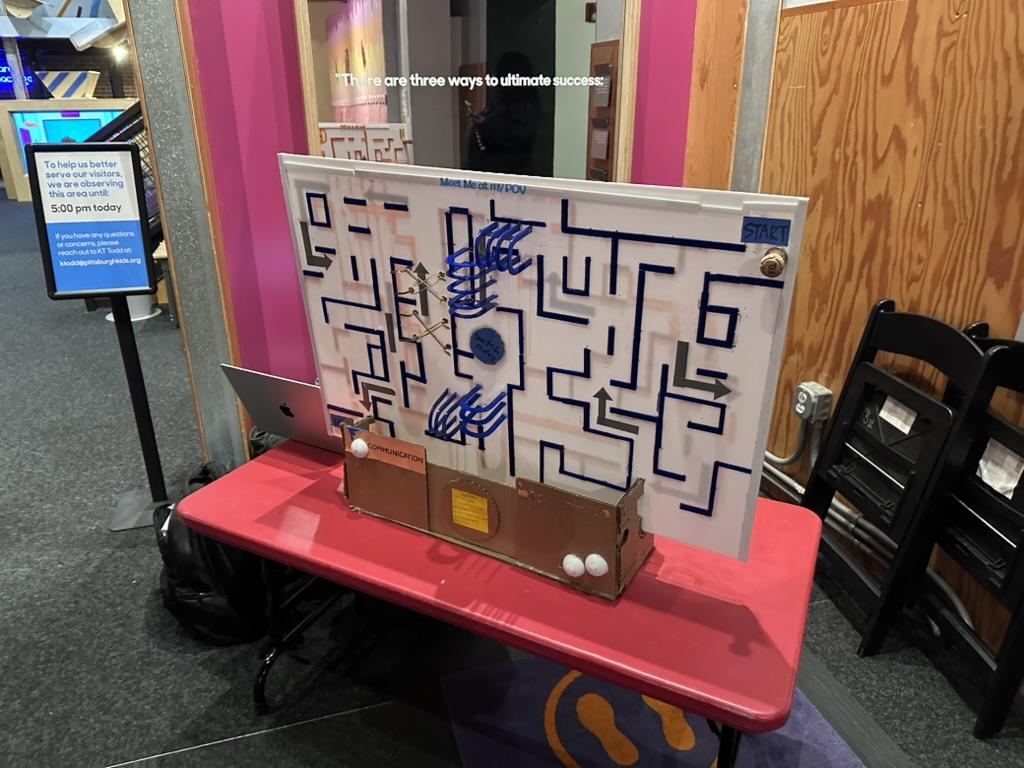
Designing for Two Perspectives at Once
The design goal was social awareness: could a maze make perspective-taking and communication unavoidable rather than optional? Each side of the board has its own path, obstacles, and hints (arrows, a rotating "switch sides" wheel, spring-coil detours) visible only to the player standing there. Neither player can win alone: every move requires asking what the other person sees, negotiating a shared strategy, and adjusting when their partner hits a wall you can't see.
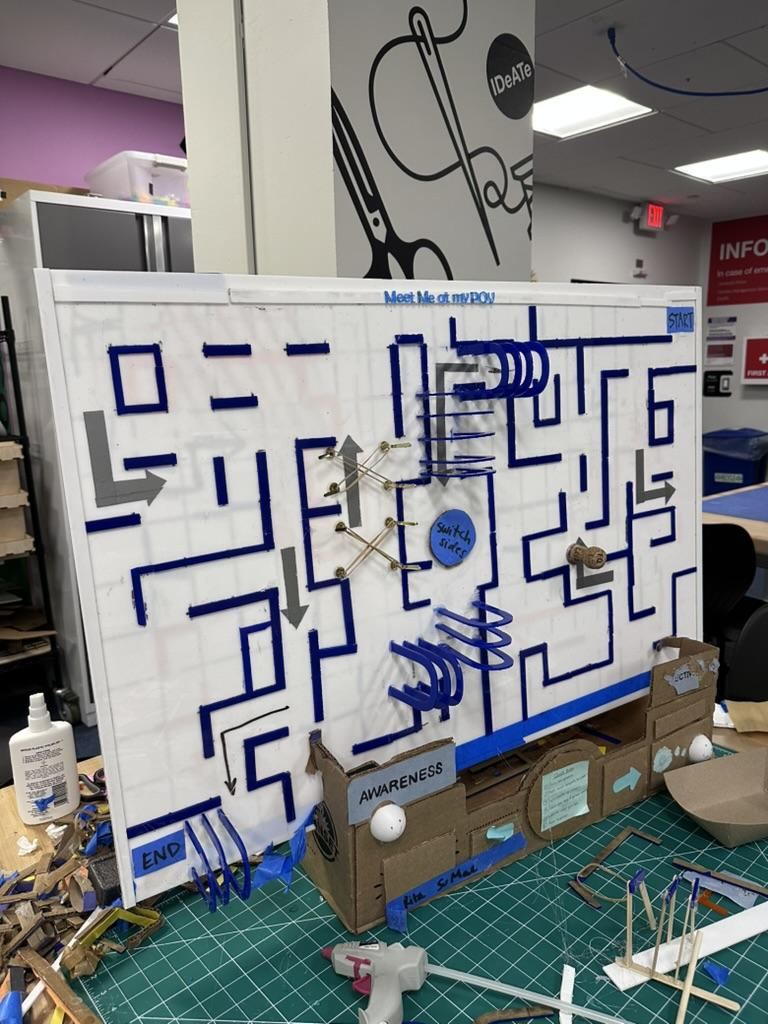
From Grid to Working Prototype
We iterated through paper layouts, a taped-out cardboard grid, and a mid-fidelity cardboard build with a working rotating dial before locking the final maze geometry and moving to the finished board. Physical constraints shaped the design as much as the SEL goals did, including magnet strength, tunnel width, and how much resistance a piece needed before a switch-sides moment actually felt like one.
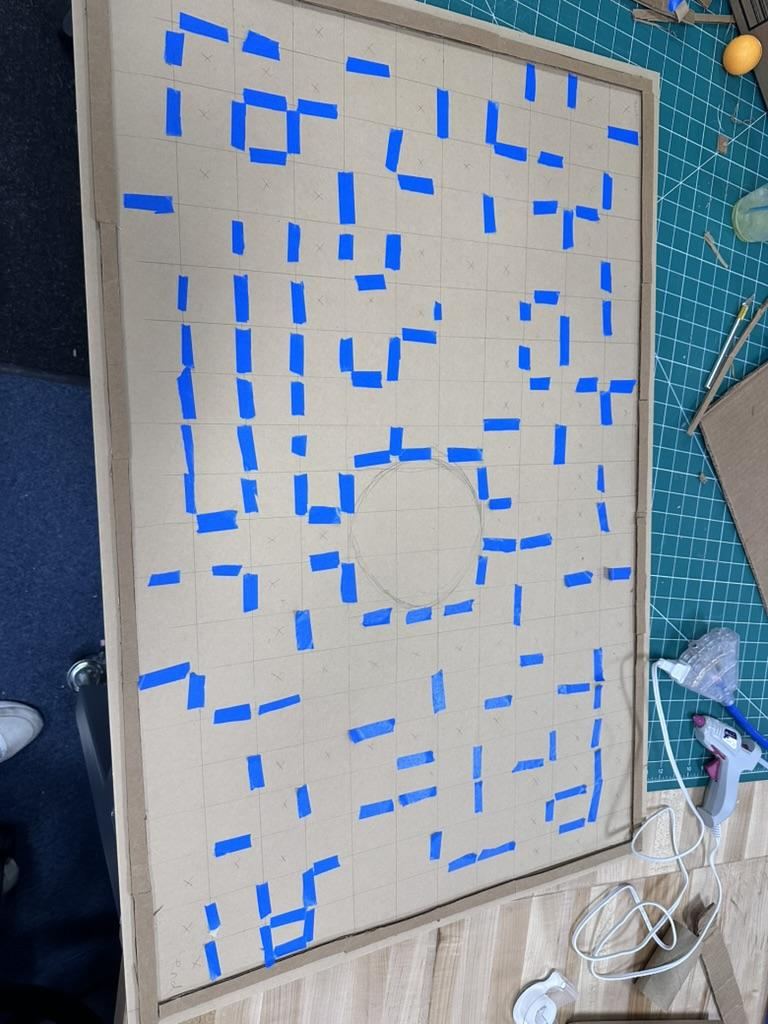 Taping out the maze grid
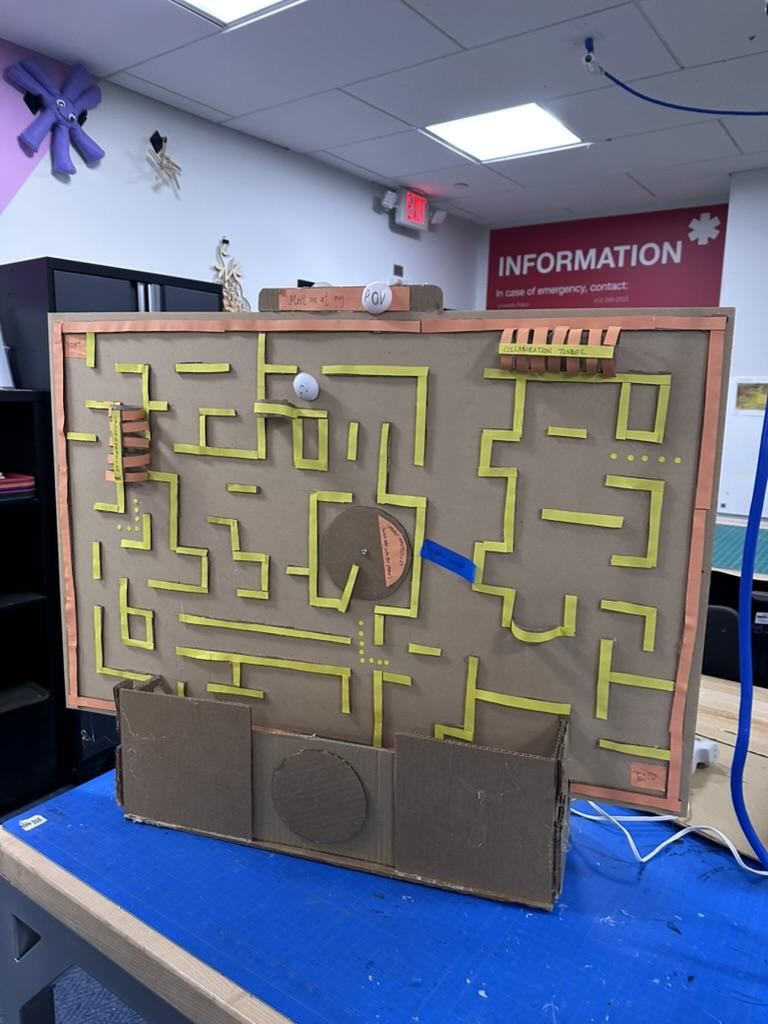 Mid-fi prototype, rotating dial + tunnel mechanic
Evaluation Design
I designed a formative study around four questions: do visitors talk about perspective-taking, do they demonstrate it during gameplay, do they show collaborative behaviors, and what usability problems come up on first contact. We observed 10 visitor groups (21 participants, ages 3–20, majority 4–8) at the Children's Museum of Pittsburgh, logging engagement time, feature use, communication patterns, and perspective-taking indicators, then ran brief exit interviews.
Engagement
How long groups stayed, and whether that time included visible collaborative problem-solving.
Communication
Directive talk, questions about the partner's side, strategy talk, negotiation.
Perspective-taking
Acknowledging the sides differ, asking what a partner sees, adapting to their constraints.
What the Data Showed
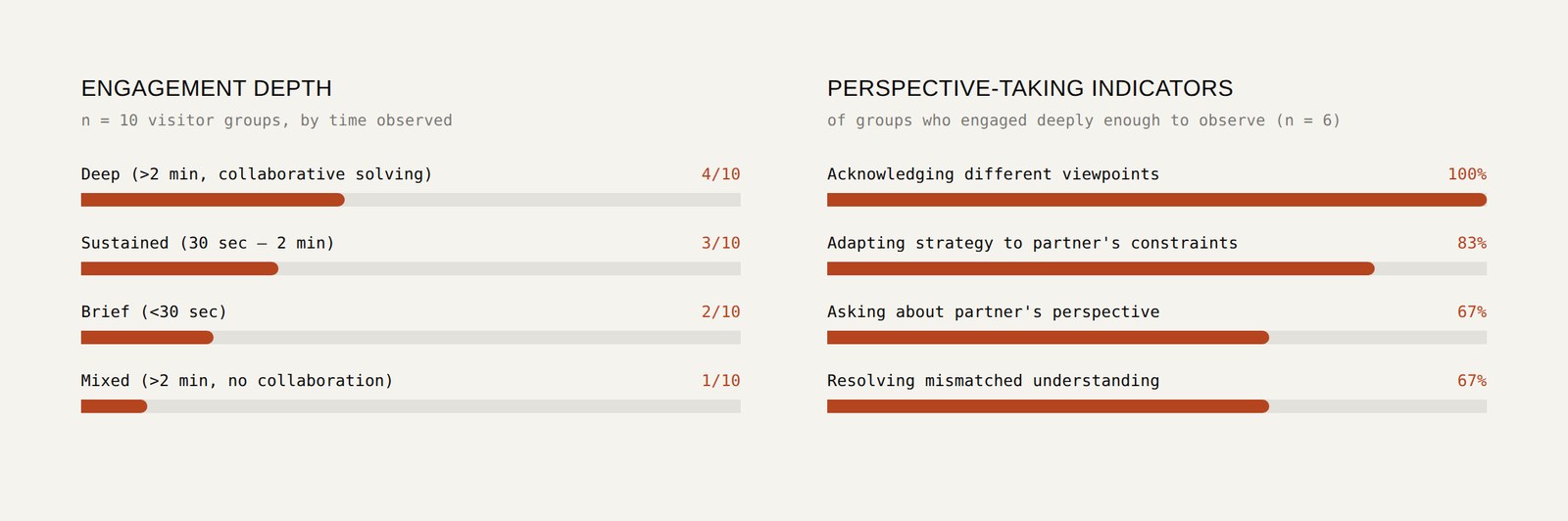
The exhibit reliably produced collaboration; it just didn't reliably produce the language of perspective-taking on its own. 4 of 10 groups engaged deeply (2+ minutes with visible collaborative solving), and every deeply-engaged group showed some form of perspective-taking: acknowledging the sides were different, adapting strategy to a partner's constraints, or both. Communication visibly evolved within a single play session, from blunt directives ("go left") toward negotiation ("if I do this, what do you do?"). But in exit interviews, 8 of 10 groups described the exhibit as being about teamwork or collaboration, while only 2 of 10 named perspective-taking specifically, suggesting the SEL goal underneath the teamwork was getting lost.
A Standout Case
A pair of young sibling visitors spent six minutes on the exhibit and built a full spontaneous communication system from scratch: pointing to indicate direction, counting down together before each move, and explicitly negotiating when one side couldn't proceed. Their language tracked the exact behaviors we were hoping to see: "You have to move the magnet for me." "Let's do it in 3, 2, 1." "What is your right?" "Wait, point and show me." It became the clearest evidence that the mechanic itself works when a group commits to it; the open question was how to get more groups to that point without a facilitator's help.