Summary
It's tough to find performance opportunities as a freelance musician. Opportunities are often found through word-of-mouth or email lists, and both event organizers and musicians on both sides can end up unaware of nearby talent. Furthermore, talented musicians new to a city struggle to break in, and communication, contracts, and payment stay confusing for everyone involved in gigs. Opus embraces the trust between peers in the music world and encourages networking, planning, and gig management in one place.
Research Findings
Musicians struggle to
- Find gigs matching their instrument
- Build credibility with strangers
- Track communication before the gig
- Get paid on time
Organizers struggle to
- Find qualified performers fast
- Evaluate applicants beyond a resume
- Know who's actually reliable
- Manage multiple applicants at once
The real challenge: building trust between musicians and organizers.
Key Features
Searchable, Filterable Gig Board
Search, filter, and toggle between In-Network and Public postings. Bookmark without opening.
Organize & Manage Events
Post events, track confirmed vs. open, and see who actually performed.
Network-Gated Profiles
Contact info is public; bio, genres, and reviews unlock only once you're connected.
Real Ensemble Confirmation Flow
Joining a group requires every current member to confirm, live.
Multi-Profile Accounts
One phone number, unlimited switchable profiles, guided by a 10-step onboarding wizard.
Editable, Data-Driven Profile
One profile object powers bio, media, ensembles, and events. Edit once, update everywhere.
Peer Recommendations
A recommendation composer replaces empty "no reviews yet" states with real endorsements.
Trust Through Networks
Mutual connections and shared history surface everywhere, not just on gig cards.
Interactive Prototype
Search the gig board, apply, organize an event, or browse a network-gated profile.
Process, Principles & What's Next
- Build trust: recommendations, shared connections, and past collaborations help organizers hire with confidence.
- Reduce friction: discovery, applications, event organizing, and network management happen in one place.
- Support real hiring behavior: Opus makes existing professional relationships visible and useful, rather than ignoring them.
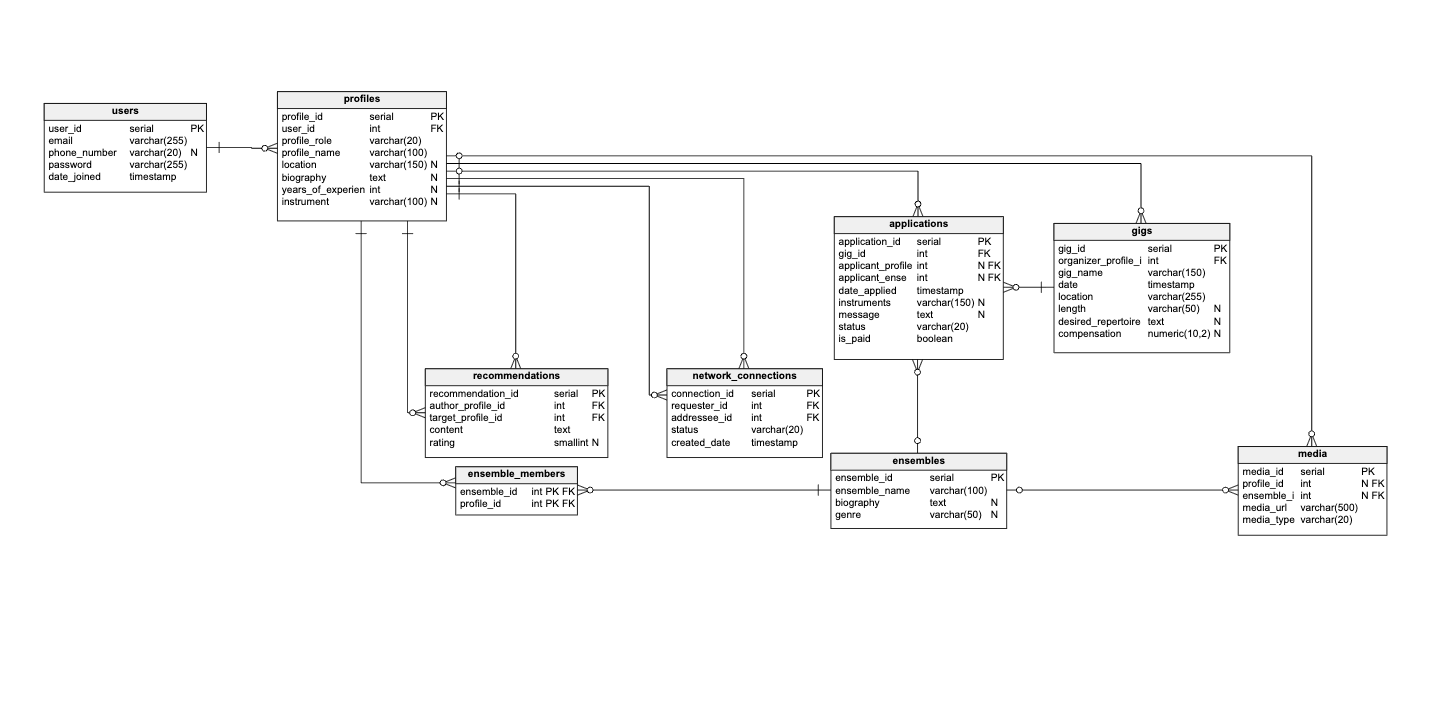
As a musician myself, this project deepened my understanding of designing marketplace products that serve two distinct user groups with different goals, and gave me hands-on experience translating a growing product surface (search and filtering, event organizing, network-gated privacy, a multi-step confirmation flow, multi-profile accounts) into information architecture and a relational database model that could actually support it.
Next steps that I would explore are built-in payment processing, real phone verification, verified references, calendar sync, contract generation, AI-powered recommendations, and reputation scoring.
Information Architecture & Database Design
Profiles sits at the center of the schema, with Connections, Ensembles, Gigs, Events, Media, and Recommendations all tracing back to the profile that owns them.