How might we make it easier and more trustworthy for musicians to discover, secure, manage, and get paid for live performance opportunities?
The Problem
Finding live performance work can be difficult for freelance musicians. Unlike industries with centralized job boards, musicians find opportunities through a variety of networks: word of mouth, professors, orchestra directors, email lists, friends. Because hiring musicians can be incredibly relationship-driven, talented musicians who are new to a city or don't know the right people struggle to find consistent work. Even after landing a gig, communication, contracts, scheduling, and payment can be confusing for everyone involved.
Research Findings
I examined the hiring workflow from both sides of the marketplace.
Musicians struggle to
- Find gigs matching their instrument and experience
- Determine whether opportunities are legitimate
- Build credibility with unfamiliar organizers
- Track communication before performances
- Receive timely payment
Organizers struggle to
- Find qualified performers quickly
- Evaluate applicants beyond a resume
- Determine whether someone is reliable
- Fill openings before event dates
- Manage communication with multiple musicians
This revealed the challenge to be building trust between musicians and organizers.
The Opportunity
Most gig platforms function as job boards, but music hiring is different. Organizers often choose performers because they've worked together before, a colleague recommended them, or a professor vouched for them. Rather than replacing professional networking, I designed a platform that embraces it: Opus, a trusted marketplace combining networking, professional portfolios, and gig management in one place.
Key Features
Searchable, Filterable Gig Board
A search bar and filter popup (instrument, number of players, location) sit above an In-Network / Public toggle, so musicians can narrow the feed to opportunities surfaced through their connections or browse the general board. Every card is bookmarkable without opening it.
Fully Data-Driven Gig Detail
Every posting has its own real instruments-needed, dress code, repertoire, payment, and apply-deadline info, plus a "why this feels safe" network-trust section and an Apply button labeled for the right applicant, an ensemble or the musician themselves.
Organize & Manage Events
Organizers post events through a slide-up form, then track them with a check or X for confirmed vs. still-open, tap in to see applicants or confirmed musicians, and revisit past events to see who actually performed.
Network-Gated Profiles
Contact info is always public, but biography, genres, and reviews stay behind a "Connect to see more" panel until that person is actually in your network, with a one-tap request to add them straight from a stranger's profile.
Real Ensemble Confirmation Flow
Creating a new ensemble adds you instantly as founder; requesting to join an existing one requires every current member to confirm, simulated with staggered live responses, and a single decline blocks the request outright.
Multi-Profile Accounts
Every profile lives under one phone number and is switchable anytime from Settings or an avatar strip. A guided 10-step wizard onboards a brand-new profile, musician or event organizer, from scratch.
Editable, Data-Driven Profile
Bio, genres, an editable "Available For" chip list, media uploads, linked ensembles, and organized events all render from the same profile object the onboarding wizard writes to, so edits update everywhere at once.
Peer Recommendations
A recommendation composer lives on every connection row, in your network list or on an ensemble member's own page, replacing an empty "no reviews yet" state with a real, attributed endorsement.
Trust Through Networks
Mutual connections, shared ensembles, and past collaborations surface throughout, on gig cards, in gig detail, and across profiles, rewarding real professional relationships instead of ignoring them.
Information Architecture & Database Design
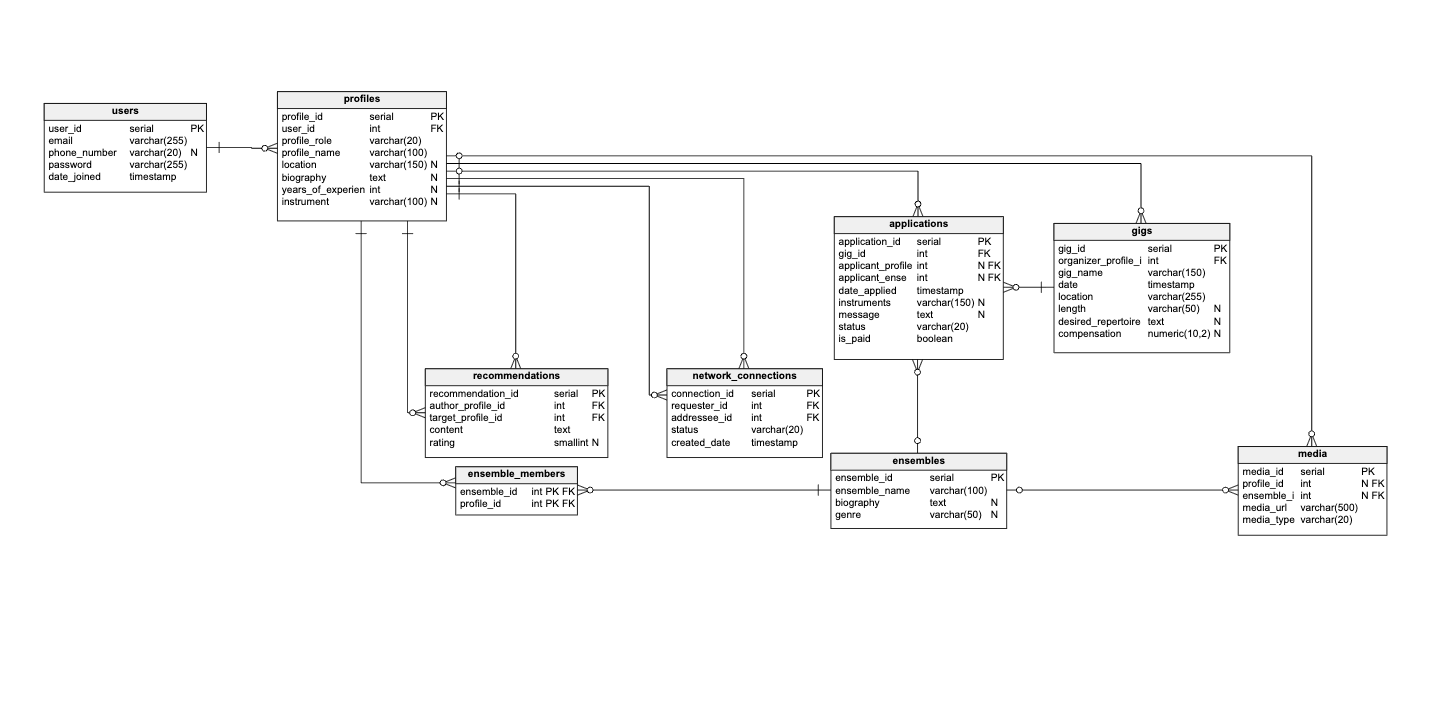
I modeled the relationships connecting profiles, the network graph, ensembles and their membership, gigs and applications, self-organized events, saved gigs, media, and peer recommendations, then translated that model into a relational schema — Profiles sits at the center, with Connections forming a self-referencing network graph, Ensemble Members and Applications as many-to-many join tables, and Gigs, Events Organized, Ensembles, Media, Saved Gigs, and Recommendations each tracing back to the profile that owns, posted, or wrote them — to validate that every feature in the prototype could be supported by a scalable backend.
Interactive Prototype
A working mockup of the Opus mobile experience — search and filter the gig board, apply to a posting, organize your own event, browse a network-gated profile, and see ensemble booking and trust signals show up throughout the interface. Scroll and tap within the frame below, or open it full screen using the button in the top-right corner.
Design Principles
- Build trust — recommendations, shared connections, and past collaborations help organizers hire with confidence.
- Reduce friction — discovery, applications, event organizing, and network management happen in one place.
- Support real hiring behavior — Opus makes existing professional relationships visible and useful, rather than ignoring them.
Reflection
As a musician myself, this project deepened my understanding of designing marketplace products that serve two distinct user groups with different goals, and gave me hands-on experience translating a growing product surface (search and filtering, event organizing, network-gated privacy, a multi-step confirmation flow, multi-profile accounts) into information architecture and a relational database model that could actually support it. Next steps I'd explore would be built-in payment processing, real phone verification, verified references, calendar sync, contract generation, AI-powered recommendations, and reputation scoring.